

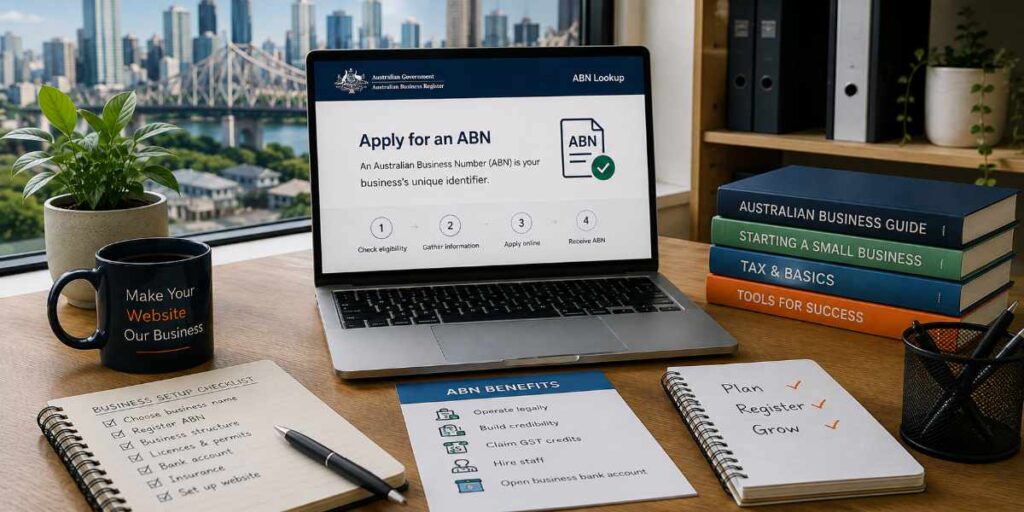
Take the next steps after registering an ABN
Once your ABN is organised, turn the idea into a workable plan. Use our guide to writing a business plan, understand small-business website costs, and review these Brisbane small-business resources. The Start & Run hub brings the core guides together.
If you are starting a business in Australia, one of the first things you are likely to come across is an ABN — Australian Business Number.
But do you actually need one? When should you apply? Does an ABN cost anything? And what is the difference between an ABN and registering a business name?
For new business owners, the registrations involved in getting started can seem more complicated than they need to be.
This guide explains the basics of ABNs and the steps to consider when establishing a small business in Australia.
Important: This guide provides general information only. Business structures, registrations and tax obligations vary. Check current requirements with the Australian Business Register, Australian Taxation Office and ASIC, and seek professional advice where appropriate.
What Is an ABN?
An Australian Business Number (ABN) is a unique 11-digit number used to identify a business or other entity when dealing with government agencies and other businesses.
Your ABN can be used on documents such as:
- Invoices
- Quotes
- Purchase orders
- Business correspondence
- Websites
- Government forms
An ABN also makes it easier for customers, suppliers and government agencies to identify your business.
Do I Need an ABN?
Not everyone earning money automatically qualifies for or requires an ABN.
An ABN is associated with carrying on an enterprise.
For example, someone establishing a genuine business providing services to customers may need an ABN, while an employee receiving wages generally does not need an ABN for that employment.
Whether you are entitled to an ABN depends on your individual circumstances and the nature of the activities you are undertaking.
The Australian Business Register provides guidance to help determine whether you are entitled to an ABN.
Does It Cost Money to Get an ABN?
Applying directly for an ABN through the Australian Business Register is free.
This is worth knowing because you may encounter commercial websites offering to arrange an ABN application for a fee.
Businesses are allowed to offer registration assistance, but you do not need to pay a third-party provider simply to submit your own ABN application.
Always check that you are using the official Australian Government website before entering personal or business information.
What Information Will You Need?
Before starting your application, it helps to have your business details organised.
Depending on your circumstances and business structure, you may be asked for information such as:
- Your proposed business activities
- Business structure
- Contact information
- Business location
- Date the business commenced or will commence
- Details of associates
- Tax File Number information
- Reasons for applying for an ABN
Having this information ready can make the application process much easier.
Step 1: Decide on Your Business Structure
Before applying for an ABN, you should understand the structure under which you intend to operate.
Common Australian business structures include:
Sole Trader
A sole trader operates a business as an individual.
This can be one of the simplest structures for starting a small business, but the individual is generally responsible for the business’s debts and obligations.
Partnership
A partnership involves two or more people or entities carrying on a business together.
A partnership has its own ABN and Tax File Number.
Company
A company is a separate legal entity.
Companies have additional registration, reporting and administrative requirements and are registered through the Australian Securities and Investments Commission (ASIC).
Trust
A trust is another structure sometimes used to operate a business, with a trustee responsible for managing the trust.
Trust structures can be more complicated and professional accounting or legal advice can be particularly valuable.
Step 2: Determine Whether You Are Entitled to an ABN
Before an ABN is issued, you need to meet the relevant eligibility requirements.
Simply wanting an ABN does not necessarily mean you are entitled to one.
You may need to demonstrate that you are starting or carrying on an enterprise.
Factors can include whether your activities have a commercial purpose, whether you intend to make a profit and whether you are taking steps consistent with establishing a business.
Check the current eligibility information provided by the Australian Business Register before applying.
Step 3: Gather Your Business Information
Next, gather the information needed for the application.
This is also a useful point to make some important business decisions.
For example:
- What will your business do?
- Where will it operate?
- What structure will you use?
- When will you start trading?
- Will you employ people?
- Will you need GST registration?
- Will you trade under your own name or a separate business name?
These decisions affect more than your ABN.
They form part of the basic foundations of your new business.
Step 4: Apply Through the Australian Business Register
ABN applications can be made through the Australian Business Register.
When applying online, follow the questions carefully and provide accurate information.
Some applications may result in an ABN being issued quickly, while others can require further information or review.
Keep a record of the information you submit and any reference numbers associated with your application.
ABN vs Business Name: What Is the Difference?
This is an area that often causes confusion.
An ABN and a business name are not the same thing.
Your ABN identifies your business or entity.
A registered business name allows you to trade under a name other than, in many cases, your own personal or registered company name.
For example, imagine Jane Smith operates as a sole trader but wants her gardening business to trade as:
Brisbane Bayside Gardens
Jane may have an ABN as a sole trader and separately register Brisbane Bayside Gardens as her business name.
Business names are registered through ASIC.
Do I Need to Register a Business Name?
That depends on the name you intend to trade under.
If you are trading under a name that needs registration, you will generally need to register it with ASIC.
Before committing to a name, check its availability.
It is also sensible to investigate:
- Business name availability
- Domain name availability
- Existing trademarks
- Similar businesses
- Social media usernames
Finding out that your preferred domain or business name is unavailable after you have already invested in branding can be frustrating and expensive.
Do I Need to Register for GST?
An ABN and GST registration are separate things.
Not every business with an ABN needs to be registered for GST.
GST registration requirements depend on factors including your GST turnover and the type of business you operate.
Thresholds and rules can change, so check the current requirements with the Australian Taxation Office rather than relying on an old article or advice from another business owner.
An accountant or registered tax professional can also help determine which registrations apply to your circumstances.
What About a Tax File Number?
Your ABN and Tax File Number serve different purposes.
Depending on your business structure, you may use an existing individual TFN or the business/entity may require its own TFN.
Tax structures can quickly become more complicated when partnerships, companies and trusts are involved.
If you are unsure which structure is appropriate, getting professional advice before registering everything can save considerable trouble later.
What Should You Do After Getting Your ABN?
Getting an ABN is only one step in establishing a business.
Your next steps may include:
- Registering your business name
- Opening a business bank account
- Setting up bookkeeping or accounting software
- Organising appropriate insurance
- Checking licences and permits
- Registering a domain name
- Setting up professional business email
- Creating your website
- Establishing a Google Business Profile
- Setting up invoicing
- Developing your marketing plan
The exact requirements will depend on what your business does.
Check Your Licences and Permits
An ABN does not automatically give you permission to undertake every type of business activity.
Some industries, occupations and locations have specific licensing, registration or permit requirements.
For a Brisbane business, requirements could potentially involve Australian Government, Queensland Government or local council regulations.
The Australian Government’s business resources and the Australian Business Licence and Information Service can help you investigate requirements that may apply.
Brisbane City Council also provides information for businesses operating within the Brisbane City Council area.
Protect Your Business Information
Starting a business usually involves creating multiple online accounts.
From the beginning, establish good security practices.
Use:
- Unique passwords
- A password manager
- Multi-factor authentication where available
- A dedicated business email address
- Secure backups
Also be cautious of unexpected emails, invoices and registration renewal notices.
New business owners can be targeted by organisations sending official-looking correspondence offering paid registrations, listings or renewals.
Always verify who you are dealing with before paying an invoice or providing account details.
Keep Your ABN Details Up to Date
Once your business is operating, do not simply forget about your ABN.
Your registration details should accurately reflect your business.
If important details change, check whether your ABN record needs to be updated.
Keeping business registrations current makes administration easier and helps customers and other businesses verify who they are dealing with.
A Simple Starting-a-Business Checklist
If you are at the beginning of your business journey, your initial checklist might look something like this:
- Develop your business idea
- Write a simple business plan
- Choose an appropriate business structure
- Check your ABN eligibility
- Apply for an ABN if required
- Register your business name if required
- Check licences and permits
- Investigate tax and GST obligations
- Organise insurance
- Set up your finances and accounting
- Register your domain name
- Create your website and business email
- Establish your marketing channels
- Start promoting your business
Not every step will apply to every business, but working through a checklist can help ensure important foundations are not overlooked.
Frequently Asked Questions
Is an ABN free?
Applying directly through the Australian Business Register does not have an application fee. Third-party businesses may charge for helping you with an application.
Can I get an ABN before I start trading?
You may be able to apply while you are taking genuine steps to start an enterprise, provided you meet the eligibility requirements. Check the current Australian Business Register guidance for your circumstances.
Is an ABN the same as a business name?
No. An ABN identifies the business or entity. A business name is the name under which you trade and, where required, is registered separately through ASIC.
Does having an ABN mean I am registered for GST?
No. ABN registration and GST registration are separate. Check the current ATO requirements to determine whether your business needs to register for GST.
Can a sole trader have an ABN?
Yes, an eligible sole trader carrying on an enterprise can have an ABN.
Where should I apply for an ABN?
Use the official Australian Business Register website. Be aware that commercial registration services may appear in search results and may charge a fee for assistance.
Getting the Foundations Right
Registering an ABN can feel like the moment your business starts becoming real.
But it is only one part of building a solid business foundation.
Take the time to understand your structure, registrations, finances and obligations before rushing into trading.
Then start putting the practical pieces in place: your bank account, accounting system, domain, website, business email and marketing.
Getting these foundations right at the beginning can make running and growing the business considerably easier later.
Continue exploring our Start & Run guides for practical information and resources to help you establish and manage your Brisbane small business.